
The fourth grader acts out. The teacher admonishes, but thinks – Oh, he has such a hard life. His parents…his peers…his siblings… I can hardy blame him for the way he behaves. And she doesn’t, for now. But where is the responsibility line: fifth grade, the day he steals for the first time, or worse? At what point will the world start to judge this young boy for his actions as opposed to pitying him because of the environment he was born in?
***
The child psychologist sat across from me. He was kind, clear and direct with his words. I liked him for this. Why waste time when there is a solution to be discussed? A small desk, littered with papers that compiled her file separated us.
“Mmm…” he muttered, “so, and I’m just guessing here, that you were nervous during your pregnancy with her.” I nodded, mentally confirming the vast understatement he had dropped on the table. Neurotic would be a more accurate term. Obsessed, terrified, and borderline personality disorder made strong showings as well, not just for the thirty-eight weeks she grew inside me, but as we talked of creating her. They lingered, tailing me even as we left the hospital with a live baby, even as we walked through our front door. Even as we pretended to know how to parent a child after burying one into the ground.
“And this?” He held up a photocopy of the recent newspaper article documenting Emma’s death and our subsequent community actions in her memory eight years later. “I read through it. You have been through a lot. So has she. It seems a lot for a child to make sense of too, doesn’t it?”
Eyebrows raised I did not answer immediately. Is he saying what I think he’s saying? Is he equating her worries and social anxieties with the fact that we talk about Emma? That we make her part of our family and don’t hold back the sisterly connection.
“Having a sister in heaven is surely not typical.” I said, my tone more even and calculated than minutes before; a non-answer to be sure. As abstract as the concept is, it is our family’s norm and our children will continue to develop their understanding of her existence with every additional year of their growth.
***
I sat clicking through my blogroll, trying to catch up. A title caught my eye, Rainer Maria Rilke, a poet. The author spoke of her instant attachment to his poetry and the revelation that he was the child after a neo-natal loss. But it was her description of what this implied that struck me speechless. She wrote, “Rainer was his mother's rainbow baby. It all makes sense, he is someone who has been shaped by grief, raised by a mother who was profoundly impacted by child loss.”
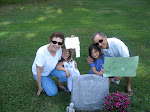
Is that the fate our living children are left to sort out? It must be for I am, without a doubt, as profoundly impacted by my daughter’s death as the word allows. And so, I am left to wonder if my children are not that different from the fourth grade boy. If every action and reaction of theirs holds some measure of my loss reflecting back at me. I’m raising them day by day, year by year, paralleled through every stage of my grief. So how can they emerge untouched by it, unshaped by my emotions? They see the melancholic joy in my face when they mention her. They feel my arms around them at her headstone every year. They feel the shift in my ways during late August and early September. They see the tears that slide down my cheeks. “Are you ok Mama?” they ask, but the answer is far too abstract and complex for explanation.
“There is so much guilt in parenting after loss” I recently said to a fellow mourner with a half smile. I am starting to make sense of its origin, yet in doing so I am beginning to fear it will never leave me. I am fearful it will implant itself in the hearts of my girls and hold tight there too, an irreconcilable and foundationless emotion they must carry for the rest of their days.
After the death of my child, I was forever changed. And for so long after that my grief was exclusive. It was mine to feel, mine to manage, mine to fight or give in to. Tangentially others were affected, yet the gaping hole existed in my heart.
The troubled young boy, the child psychologist, Rainer Maria Rilke, and Anarcharist Mom all point to the same conclusion. Even before their conception, my children were too. Just by existing in our home, they are being shaped by both grief and love.
How does grief shape your life?
Showing posts with label subsequent children. Show all posts
Showing posts with label subsequent children. Show all posts
Wednesday, February 4, 2009

Subscribe to:
Posts (Atom)


.jpg)








 Posts
Posts


